
Paul Jordan is a records management specialist at the Jet Propulsion Laboratory (JPL) in Pasadena, CA. He’s also my son who sends home fascinating emails about his work. This one, on the Mars Yard at JPL, has nothing to do with media, but it says a lot about the power of science and what we can accomplish when we work together.

Today, I was at JPL (the “Lab”) working through our backlog. As a break from processing old records, I decided to go see the Mars Yard. That’s the outdoor area where the Mars rover doubles do tests to help plan activities on Mars. Though it’s open to JPLers, I had never visited it. We have two interns (both at UCLA’s library/archive school) with us this summer, who also hadn’t seen the Yard, so the three of us went up to see what we could see.
JPL is built into the side of a hill, and the Yard is located at almost the very top of the main Lab area. The building I work in is most of the way up, which means I need to walk down if I want to go to the cafeteria or the mall. The credit union is all the way down at the bottom of the hill, while the Mars Yard is basically as far up the hill as you can get before you reach the steep slope that heads up to the Mesa.
As a side note, JPL has a fair amount of area on that high mesa, though I’m not sure exactly what’s there. Most of us have never had a reason to go there, though I do know that’s where JPL’s two million gallon water tank is. It has ports built specifically so fire fighting helicopters can reload their dump tanks, and was used heavily during the massive Altadena wildfire in January. The helicopters didn’t have to travel far between recharging from our reserve and the drop zones, as that fire was only a couple hundred yards away.
We came within a hair’s breadth of losing the Lab in January. If the fire had crested one more hill, all of the firefighting personnel would have had to be evacuated and the Lab would have burned.
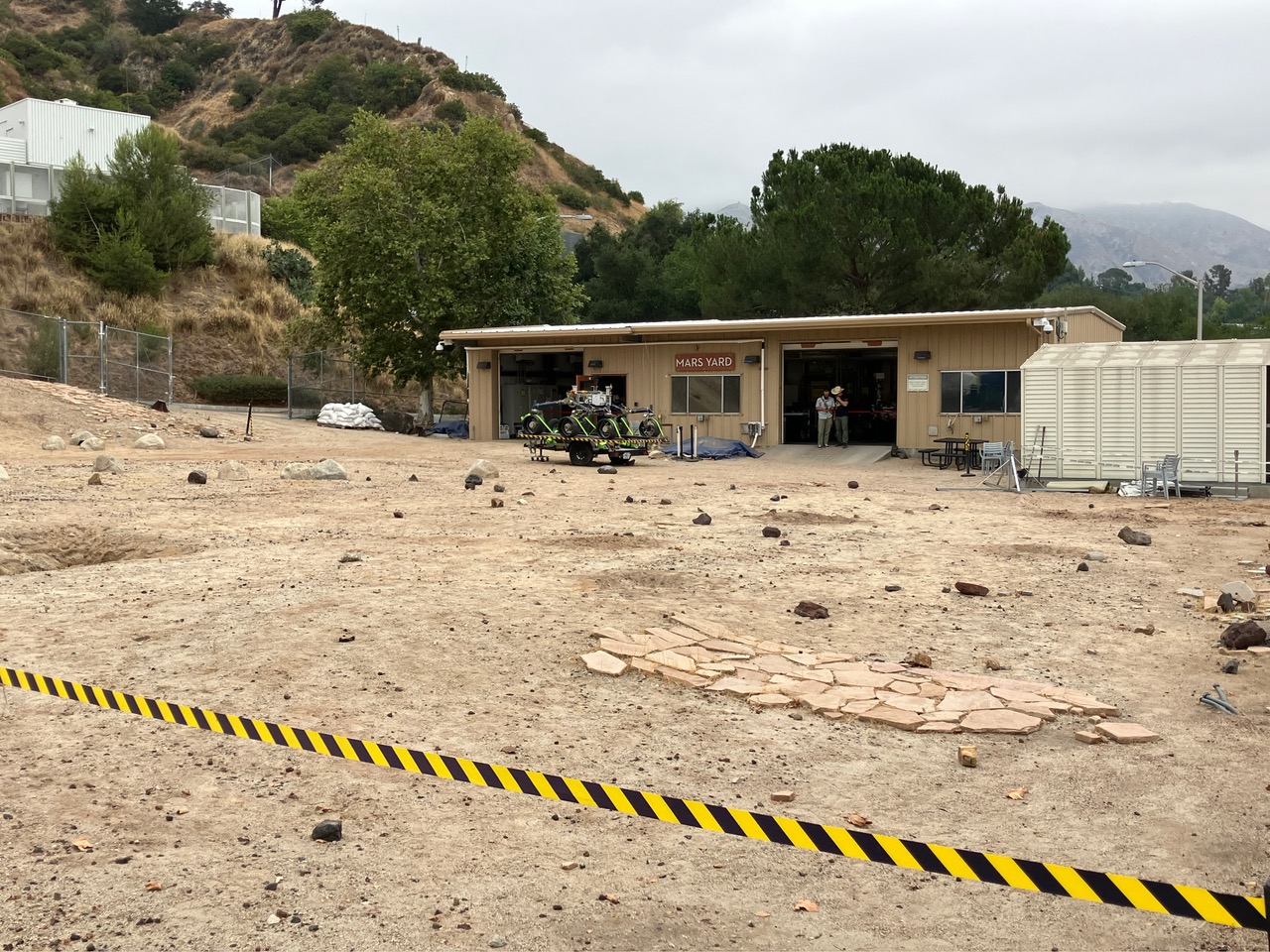
Mars Yard from the observation platform. Click to see larger image. Photo courtesy: Paul Jordan.
Anyway, back to more pleasant matters. To get to the Mars Yard you climb a steep staircase that’s a little hidden at the back of a short road that branches off the main east/west road. At the top of the stairs is a little observation area, roped off with striped caution tape, that looks into the dirt yard and its varied rocks, some of which have been put into formations and others are strewn loose.
We thought we’d just stay at the observation area for a little bit, take a few pictures, and then leave. But the Yard building was open and there was a guy in the doorway. When he saw us, he waved us over, much to our delight. This is one of the great things about JPL; so many people are happy and eager to share what they’re doing.
He gave the three of us a tour of the Yard’s garage, joined eventually by his colleague, who was trying to troubleshoot why he wasn’t able to drive the stripped-down rover out in the Yard by using his cell phone.
Behind the garage’s two doors are the test rovers for Curiosity and Perseverance.
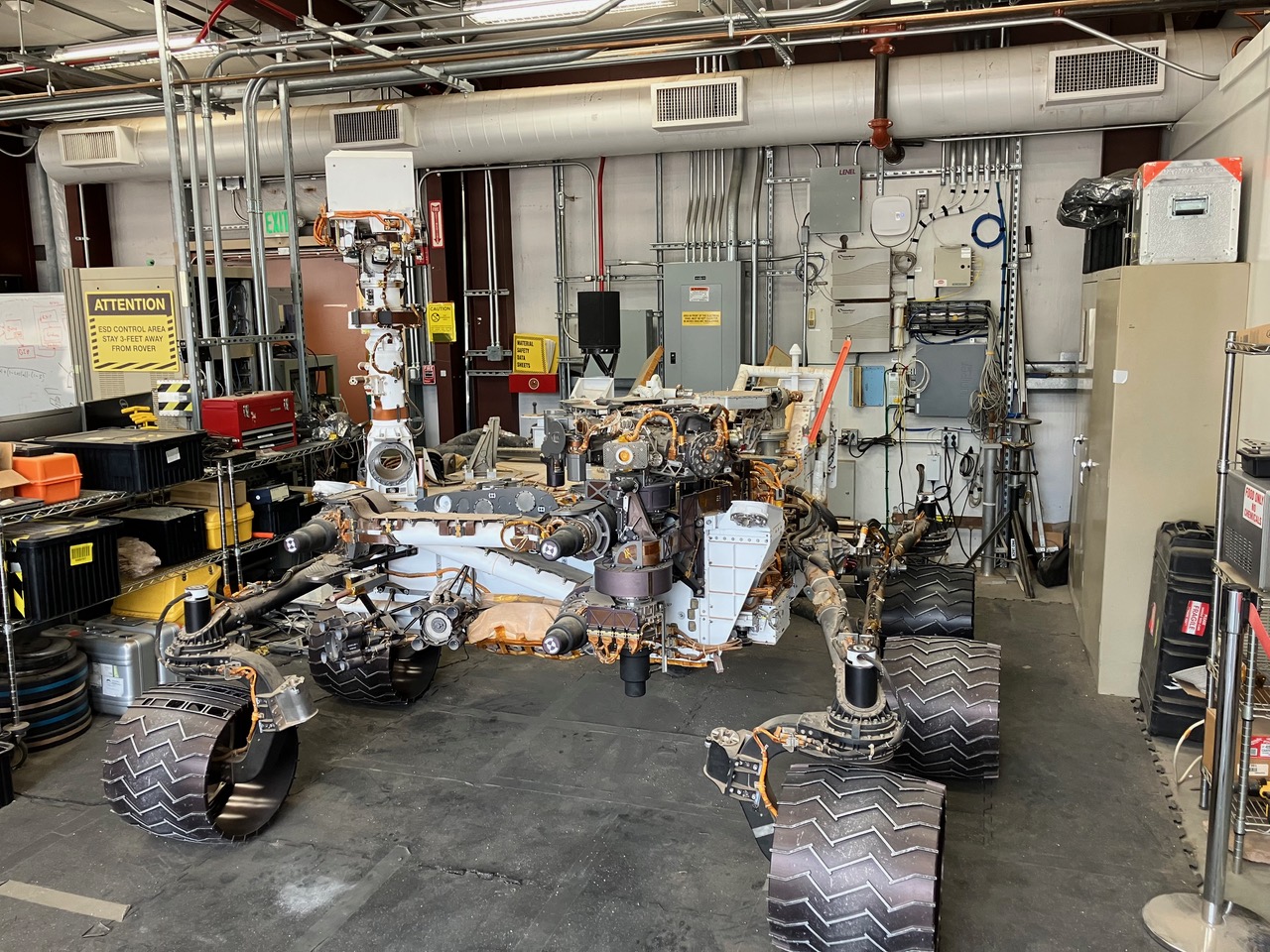
Maggie – Curiosity’s double. Click to see larger image. Photo courtesy: Paul Jordan.
Curiosity’s double is called MAGGIE (Mars Automated Giant Gizmo for Integrated Engineering).
Larry adds: And who says engineers don’t have a sense of humor?
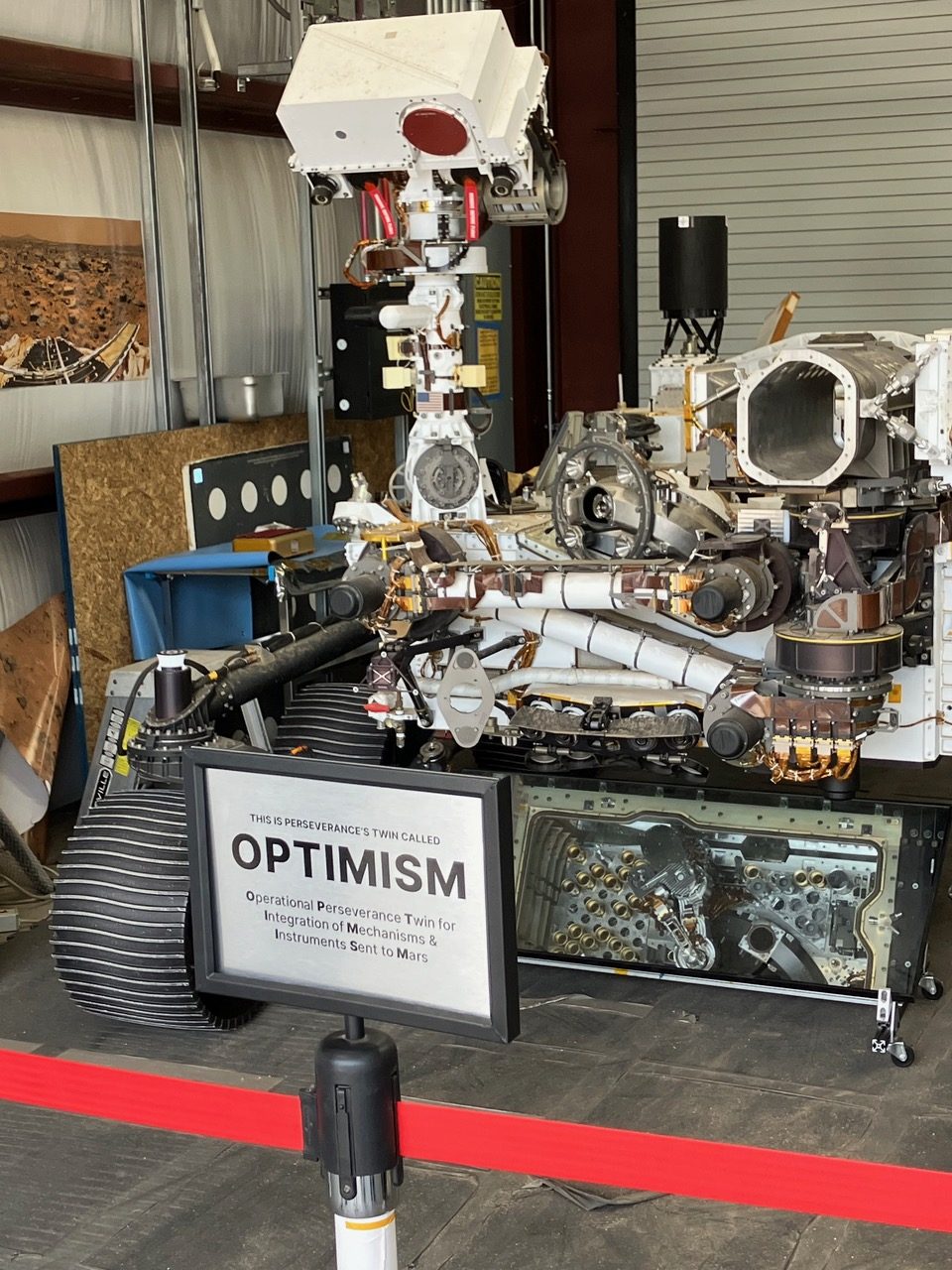
Optimism, Perseverance’s double. Click to see larger image. Photo courtesy: Paul Jordan.
Perseverance’s double is called OPTIMISM (Operational Perseverance Twin for Integration of Mechanisms & Instruments Sent to Mars).
Outside in the yard, loaded onto a transport, was a stripped down version of just the wheels and drive train called the Scarecrow. It was being readied to be taken to Dodger Stadium over the weekend for JPL’s yearly “JPL day at the baseball game,” which is a big deal. The event showcases a number of science demos from JPL for the public to see. (These demos were why that second engineer was trying to re-enable driving the Scarecrow with a cell phone).
The guys were really gracious in showing us around and talking us through what these mechanical doubles were and how they were used. In addition to the car-sized rovers, the garage had a variety of additional rover hardware that had been used in testing over the years.
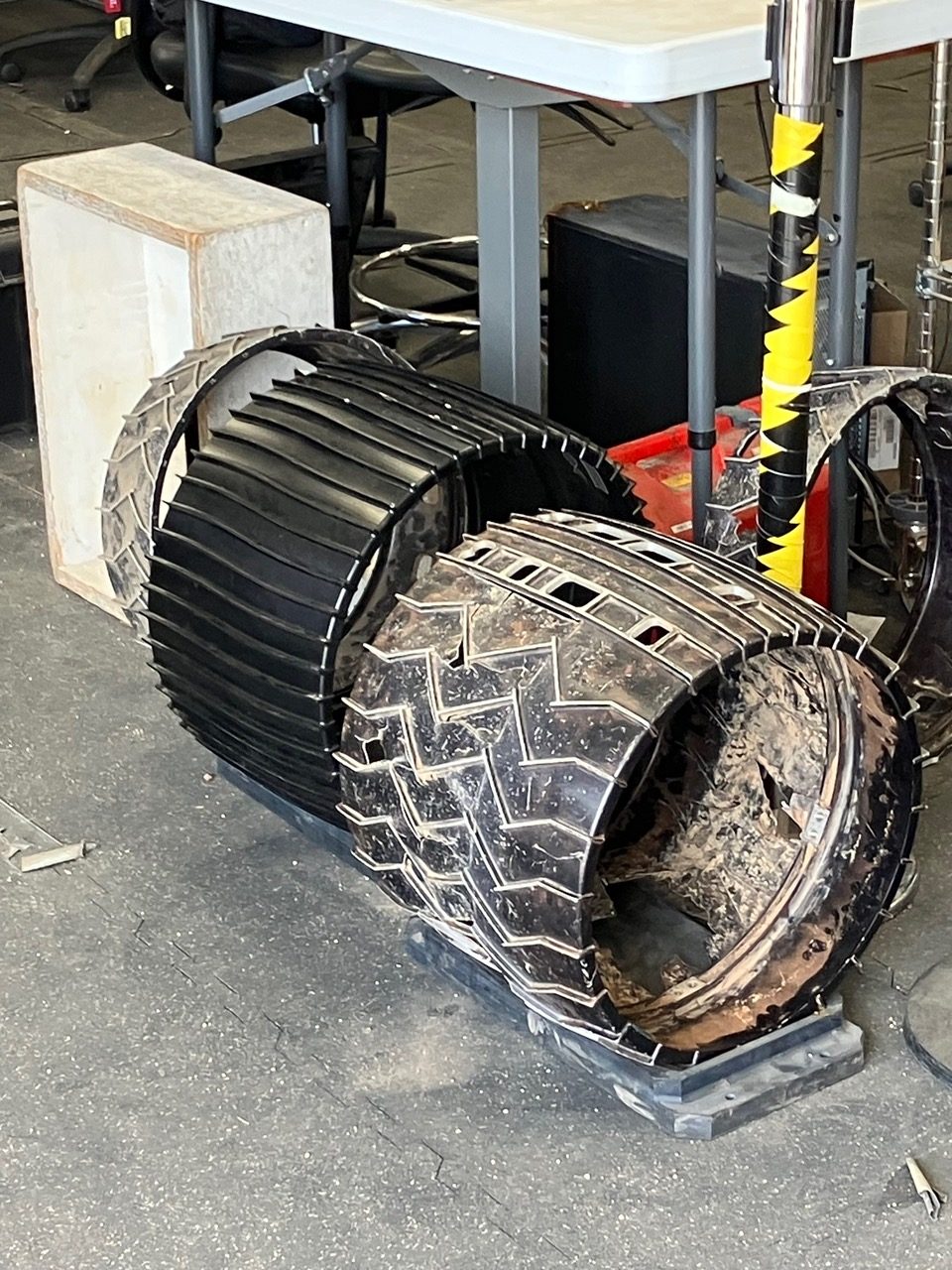
Test wheels for both rovers; note the holes in the Curiosity wheel closest to camera. The tests done on that wheel are why Perseverance’s wheels are uniform and don’t have JPL in Morse code. Click to see larger image. Photo courtesy: Paul Jordan.
The real highlight for me was being able to see the actual hardware that is used and tested. There’s something even more impressive about seeing wheels that have actual dirt on them, or wheels being tested until they fail, than clean wheels in a museum setting.
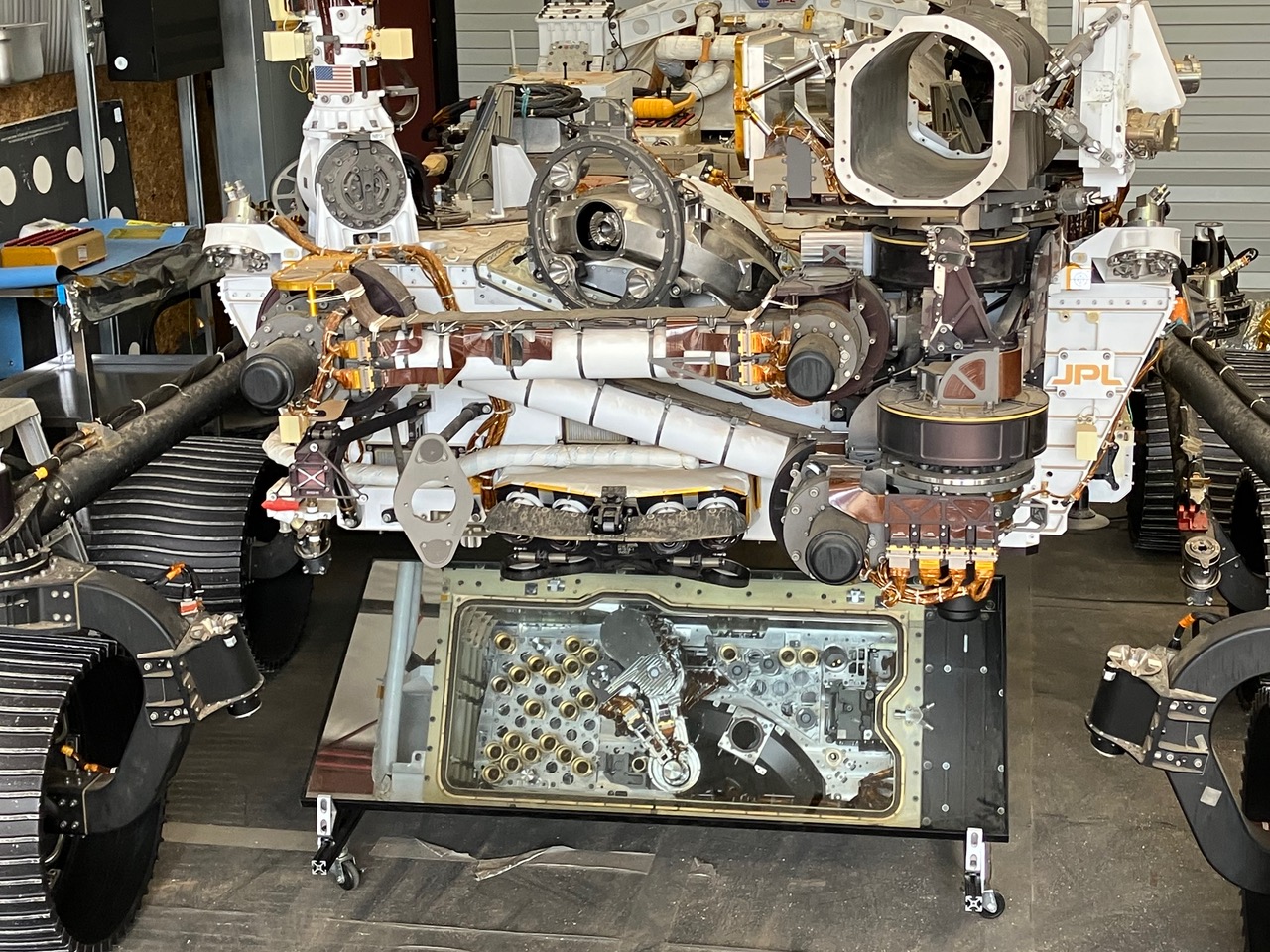
The mirror underneath the Perseverance rover model, showing the rock sample collection mechanism, including the robotic arm that maneuvers everything around. Click to see larger image. Photo courtesy: Paul Jordan.
Also impressive was the angled mirror underneath the Perseverance model. This showed the rock sample collection storage area, and the robot arm that selects and moves around the sample containers. It’s like the most precise selector arm from a jukebox that still uses records ever made.
When the guy who was doing the nav software troubleshooting resolved the issue, he joined us. He’d been working with JPL for over 20 years, and shared some fun stories. First he gave the interns a detailed explanation of why static was such a threat to the rovers. This was prompted by a question about an odd contraption he was wearing. He was in a lab coat which had an alligator clip clipped onto one of the coat’s lapels. That clip was at one end of a black cable twisted much like an old phone cord that stretched somewhat awkwardly over the back of his neck to a wrist band on his opposite wrist. It apparently dealt with any static that would build up as he moved around.
Fun facts from that talk: the static shock you’ll get from scuffing your feet across carpet is 10,000 volts. The electronics in the rovers will fail at 50 volts. It’s entirely possible to break the rover with a shock that you don’t even feel, and the piece won’t fail until weeks later. And then it’s only possible to figure out by pulling the piece and looking for static-caused craters in the electronics under a microscope.
This is also why all of the hardware build books that I get come in special blue binders that are tacky to the touch. A normal binder will store a static charge and pass it on. These binders will absorb up to (if I remember correctly) one megavolt. So they’re safe to be referenced around delicate components.
Another fun story was from the effort to rescue the Spirit rover in 2009. Apparently, none of the Mars rovers (including the two active ones) can tell the difference between sinking and slipping. Sinking is how you kill rovers, and slipping is how the wheels move forward in normal driving. It’s amazing how much they’ve been able to accomplish given all of the limits on, well, everything.
Anyway, Spirit had gotten stuck sinking into some sort of soft, powdery sand that the engineers couldn’t identify. And it was a race against time, because winter was coming and the solar panels were pointed away from the sun. No one could figure out an analogue, until one of the engineers was cleaning out his pool filter for the start of summer. The process required diatomaceous earth, and when the engineer felt it, he realized it was a perfect duplicate.
So he went running into the office, waving his bag of diatomaceous earth at his colleagues, all of whom agreed that it was the perfect analogue. Finally knowing what they needed, all of the engineers on the Mars Exploration Rover (MER) project fanned out across LA, hitting every pool supply store they could find. They bought out basically the city’s entire supply of diatomaceous earth, and shipped literal tons of the material back to JPL so they could build a test environment to get Spirit free.
Fun fact about diatomaceous earth: it’s a component in making explosives. And while many engineers were making the purchases, they were all using the same JPL credit card. So to the outside, it looked like one JPL business admin was buying it all. The FBI got involved, and the poor admin got put on the Do Not Fly list. I don’t know if the FBI actually came to the Lab, but from what our guy was saying, it took the MER project lead going to JPL’s chief scientist, then the JPL Director, then the NASA Director, and then the NASA Director calling the FBI director to get the situation resolved.
After testing, they realized the best chance to get Spirit out was for it to run in reverse at full power. And that they really needed to avoid soft sand like that in the future, which they have done with all of the rovers ever since.
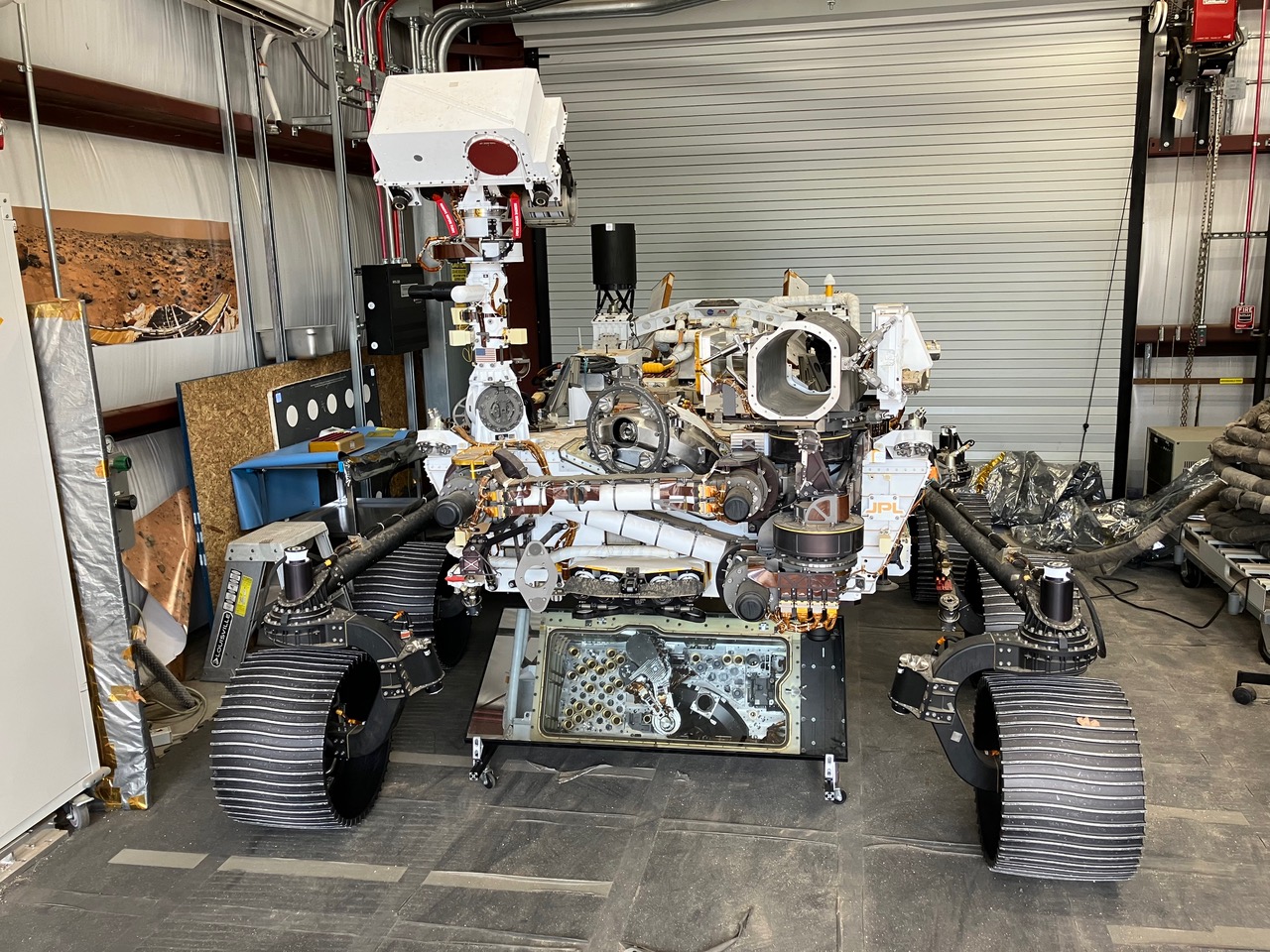
Perseverance double from the front. Click to see larger image. Photo courtesy: Paul Jordan.
After about twenty minutes of chatting, the two interns and I thanked the two Yard guys profusely, took a few more pictures, and headed back to work. I hope you’ve enjoyed this brief excursion to a part of JPL I hadn’t been to before.
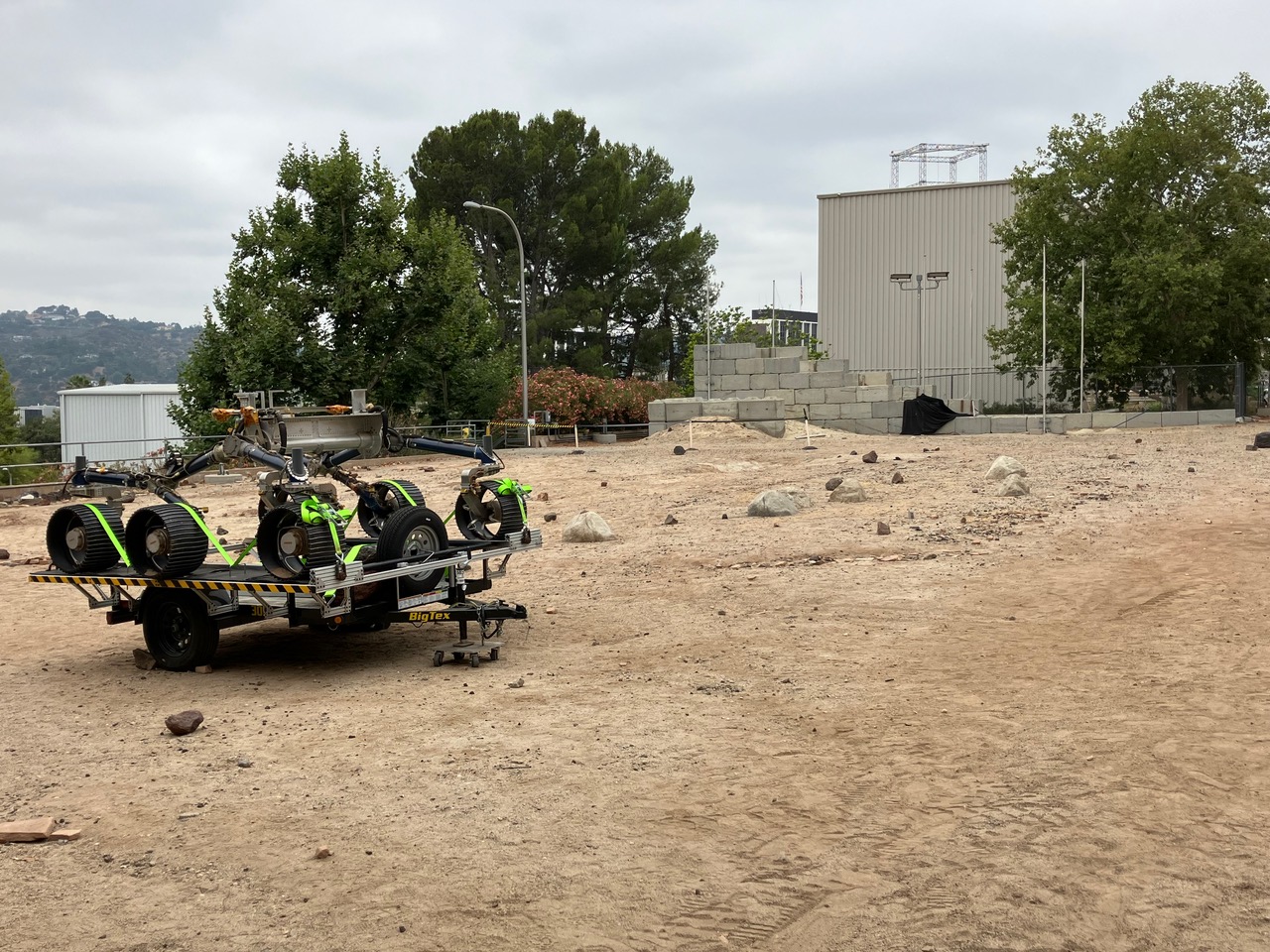
Mars Yard from Perseverence’s doorway. Scarecrow readied for transport in the foreground. The observation area and stairs down are in the far center, behind the yellow and black tape. Click to see larger image. Photo courtesy: Paul Jordan.



One Response to Behind-the-Scenes of Mars on Earth – The Mars Yard at JPL
Thanks Paul. While living our everyday lives – however interesting, it’s always amazing to hear of insurmountable problems being solved creatively. Sometimes, I wish that engineers could work unhindered at the top, running governments. JPL must be one unique place to work. All the best, Greg