[This article is part of a series where I invited media industry leaders to share their thoughts on 2025 and what it means for the future. Bram Desmet is the CEO & GM of Flanders Scientific. Website: FlandersScientific.com. ]
Looking Back at a Turbulent 2025 — and Forward with Cautious Optimism
 There’s no question that 2025 has been a challenging year for the professional video industry. Production activity has been wildly inconsistent, budgets remain under pressure, and many of the assumptions that drove the past decade of growth — around streaming demand, rapid technology refresh cycles, and ever-expanding content pipelines — have been put to the test. For creatives, engineers, and businesses alike, this year has forced meaningful reflection and, in many cases, a recalibration of business models.
This recalibration has taken many forms. The industry has already seen — and will likely continue to see — significant consolidation, while many independent operators are diversifying their services into broader, and sometimes less traditional, markets. Facilities are also becoming far more deliberate with capital expenditures, prioritizing investments in tools that can serve multiple roles rather than highly specialized, single-purpose solutions. In the context of reference monitoring, this has increasingly meant choosing displays that can function reliably both on set and in post-production, maximizing utilization while minimizing redundancy. In some cases, this shift has also led to a new paradigm in which a single large-format display serves as both the colorist’s primary reference monitor and the client display, replacing what was traditionally two separate investments within a grading suite.
Periods of constraint, however, often bring clarity. One of the more notable shifts I’ve observed is a renewed emphasis on practicality in production workflows. There is far less appetite for solutions that look impressive on paper but are difficult to deploy, maintain, or justify financially. The tools that succeed today are the ones that deliver clear, tangible value — not just incremental technical improvements.
HDR is a good example of this dynamic. For years, there has been a disconnect between production and post, with meaningful HDR visualization often limited to the later stages of post-production. This was driven, at least in part, by the high cost and impractical form factors of traditional HDR reference displays. Outside of very high-budget projects, few productions were willing to pay for, insure, transport, and power a $35,000, 60-pound, 31-inch monitor on set. As a result, most productions continued to monitor in SDR during production and deferred HDR decisions until post.
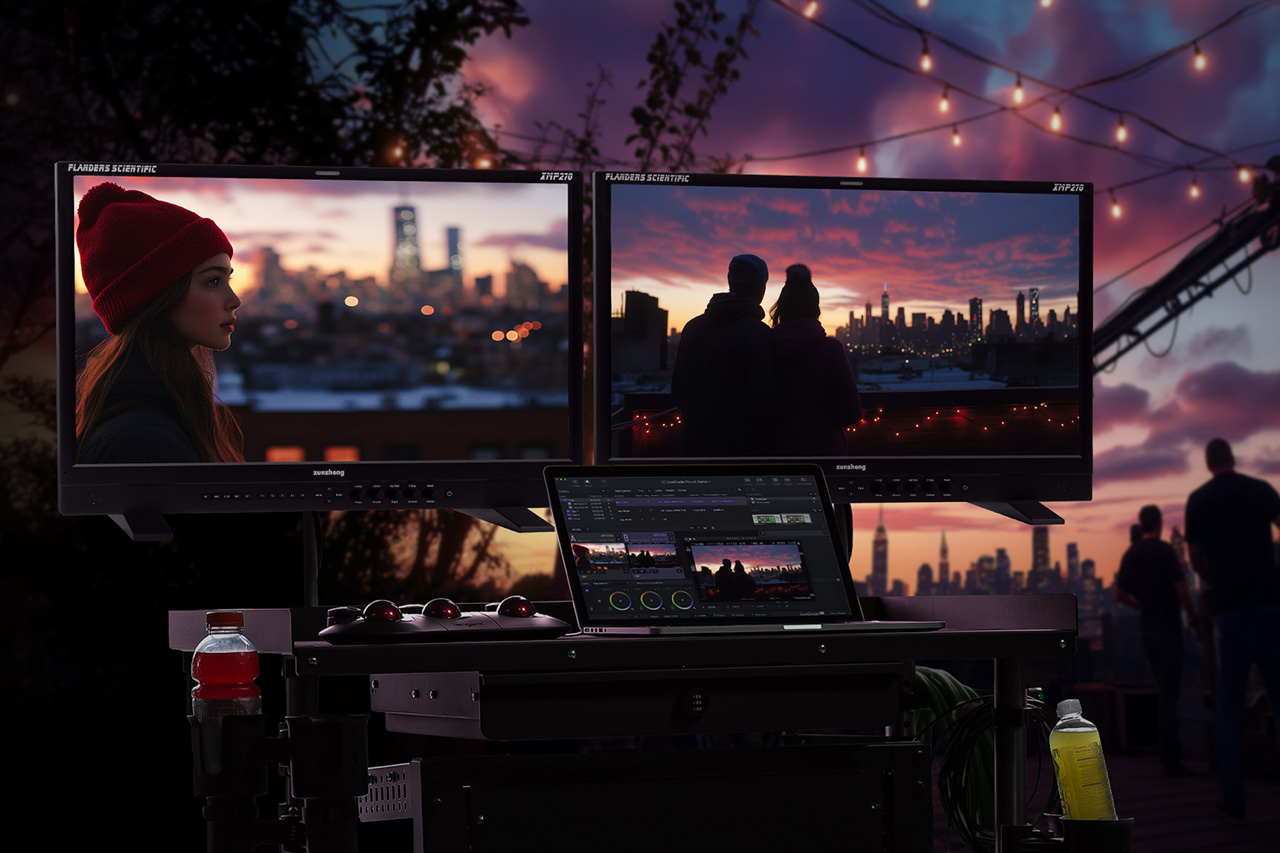
That workflow introduced a meaningful creative disconnect. Directors, DITs, and producers often saw one image on set and a materially different one in post. In practice, this frequently led to HDR finishes that preserved a largely “SDR” aesthetic — not necessarily as a result of conscious creative intent, but as a result of a primacy effect shaped by what was seen during production. This isn’t to suggest that an SDR aesthetic is inherently wrong when it is a conscious creative choice. Rather, it highlights how often that outcome was driven by technical and logistical limitations rather than deliberate artistic direction.
Over the past year, advances in QD-OLED display technology have begun to change that equation. By combining high peak luminance, true blacks, and excellent color volume in a far more efficient package, these displays have made HDR monitoring significantly more accessible and practical in real-world production environments. Lighter weight, lower power consumption, and quieter operation may sound like secondary considerations, but on set, in smaller grading suites, or in mobile workflows, they matter enormously.
At Flanders Scientific, our focus has been on using these advances to reduce friction rather than add complexity — building reference-grade monitors that can be confidently used for HDR work on set, at a fraction of the cost of earlier HDR solutions, and in form factors that better reflect how people actually work today. The goal isn’t to lower standards; it’s to make high standards achievable for more creators and facilities. With the ability to monitor HDR more practically much earlier in the production process, I expect creatives to make more intentional choices — whether that means fully embracing what HDR offers or consciously maintaining an SDR aesthetic when it best serves the story.
Looking ahead, I remain cautiously optimistic. While the industry is still finding its footing, the underlying creative demand hasn’t disappeared. If anything, the need for tools that are accurate, reliable, and economically sensible has never been greater. I believe the next phase of growth will be less about spectacle and more about sustainability — solutions that respect both creative intent and operational realities.
If 2025 has taught us anything, it’s that resilience in this industry comes from adaptability. The companies and creatives who thrive will be those who embrace technologies that genuinely make their work better, easier, and more attainable — not just newer.