[ This is a transcript of an interview of Larry Jordan, conducted by Cirina Catania for OWC Radio – Dec. 27, 2024.
Here’s the link to the original audio interview.]
Cirina Catania: Larry Jordan is one of our creative tech industry’s most intelligent, talented, and prolific trainers, and someone I worked with for over 11 years, so this is a fun interview.
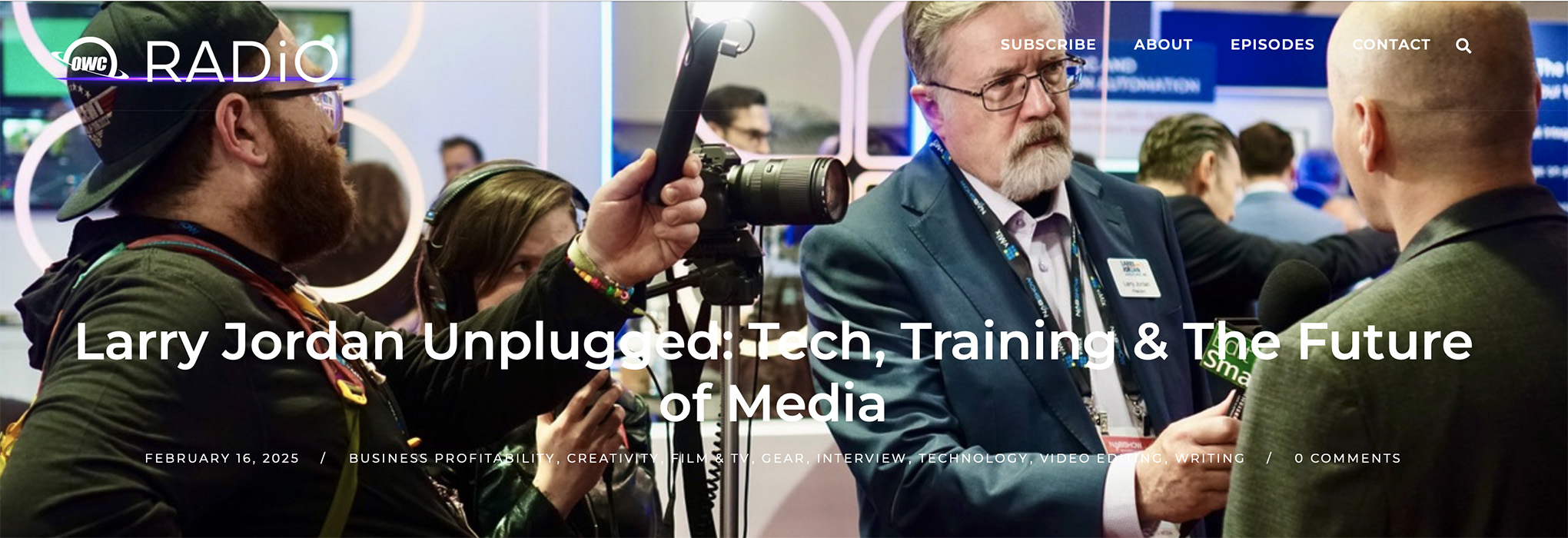
He’s a member of several guilds, worked in live television and the broadcast industry as a producer/director for many, many years, and started his company, Larry Jordan & Associates, because he enjoyed communicating with and helping people who wanted answers on how to edit smarter, better, and maybe just upgrade their skills so that they could make a more lucrative living.
21 years later, he has published over 3,200 reviews and tutorials, 570 45-minute training webinars, 700 YouTube tutorials, and in his spare time, published 13 books. Whether you’re a trainer wanting to upgrade your skills, an editor looking for answers, or simply someone who works in the creative industry and would like some advice about your future, this is the conversation to which you will want to listen.
Stand by. It’s getting good.
Announcer: It’s time for OWC RADiO, tech talk with creatives, conversations with host Cirina Catania.
Cirina: Welcome, Larry. I’m so happy to see you on here, and I know you’re really busy, so this is very special to me.
And for those of you listening, Larry and I have a long history working together, and I just wanted to say welcome to OWC Radio.
Larry: Cirina, it’s a delight. You know, we worked together for almost 12 years on the Digital Production Buzz, then you left me, in the lurch, all alone. I had no one to talk to. Now being able to see you again is great. Thanks for inviting me on the show
Cirina: Yes, it’s wonderful. Well, you are for many, many people, the tech guru, and I have been with you so many years when we were at NAB doing the Digital Production Buzz. And I watched these starry-eyed, young kids coming up to you going, “Oh, my God, you’re Larry Jordan.” And I don’t mean to embarrass you with that. But it’s, it’s just nice.
Can you talk about when you were doing a lot of live TV and because you’re a member of the Director’s Guild and the Producer’s Guild. So give us a little bit of your background.
Larry: Can I tell you more about my background? Yes, I can. You know, you and I have got to talk about how to ask better interview questions.
Cirina: (laughing) You would have made, and you still could do it, a broadcast television news anchor. I’ve told you that for years. You are a Walter Cronkite. I’m like conversational podcasting. Hey, tell me about this.
Larry: I just think of you as Connie Chung, really.
Cirina: I think…
Larry: You’ve threatened to turn me into a broadcast anchor since I first met you, and, I’m still waiting. I’m here. I’m saying yes, you just have to say go.
Cirina, in answer to your question I think if you were to categorize my career over the last 20 years, I teach media professionals how to create television and film programs and I teach people all over the world.
Long before you were born, I got my start in broadcast television. I went to graduate school at the University of Wisconsin-Madison. Then my first job out of graduate school was at WRWC-FM, a radio station in Rockton, Illinois. I was broadcasting beautiful music mostly to cattle and sheep. Every 15 minutes I’d say: “That was the Montevanni strings, coming up next is the Boston Pops.” Then, after about 15 minutes, I’d say: “That was the Boston Pops, coming up next is the Montevanni Strings.” We just alternated back and forth, the sheep were dancing in their pen and I was in hog heaven. It was great.
It lasted for three months. Then, the program director called me into his office and said, “Son,” (because I was younger then), “Son,” he said, “you are a second tenor. We need a baritone. Enjoy the rest of your life.”
My burgeoning career in broadcast radio shattered at that moment.
Fortunately the same day I was fired in radio, I was hired in television and my career instantly shifted. I went to work for WHA-TV in Madison and worked there for the rest of graduate school. Next, I went to Montana to work for a broadcast station in Missoula, from there to broadcast TV in Maryland, from Maryland I went to PBS, and from PBS to Boston.
So the first third of my career was all broadcast television as a producer/director. I’ve done local shows and I’ve done national shows. My speciality was live, special events. (I’ve had a love of live all my life.)
Then second third of my career was software marketing. This was back in the early ’80s when the Apple 2e captured the world’s imagination of being able to put a computer on your desk, which was unheard of. Because before that it was mainframes and minis. There was a computer store down the street from me, and I went in there and started working part-time as a straight-commissioned salesperson, and fell in love with it.
For some reason, which is still pretty vague to me, I decided to jump out of broadcast television and get into computers, starting with computer sales and computer marketing.
I worked for a variety of computer firms from then until about the late 90s, at which point I said, “You know, I’m getting really bored.” I kept getting laid off from more and more companies because people would hire you, they’d work you for six months, realize they had too many staff and fire you again. I got tired of that after the seventh company. So, I said I should start my own company. In 1997 I started a company which specialized in creating informational DVDs.
Back then, as you know, DVDs were the communications media because the internet had not yet taken off to the level that we know it today. M company would go to trade shows like an NAB or a medical show, we would record all the conference sessions, transcribe them into text, and then burn that as interactive, searchable text on to a DVD. We did about 50 titles in four years.
Then the internet took off and all of that information was now available For free online. I discovered that I can’t run a business with 25 people competing against free. So that business closed down and I was looking around for something else to do.
My next company, which I’m still running now, is a training company enabling media creators to use hardware and software tools to tell stories using pictures. I train on Adobe and Apple and Blackmagic Design software and integrate production and post-production, but mostly post-production.
That took off, and I’ve been doing training now for the last 21 years. As part of that, I publish a newsletter every week and do training and online speeches and webinars and travel around consulting, but it’s all trying to help people Improve their ability to tell stories using pictures.
That is a surprisingly easy thing to say and very difficult thing to do
Cirina: It is, but you’re so good at it. You know what? This walk down memory lane is reminding me. I had totally forgotten. I took my very first Final Cut class from you. What was the name of that store?
Larry: It was on the second floor of an Apple computer store in Santa Monica, California, and the training was provided by DV Creators.net.
Cirina: Yes, I think it was. It was Final Cut, the very first iteration of Final Cut. And for some of the teachers that are listening, one of the things that I want to ask you is what do you think makes you a good teacher. I can tell you, as one of your former students, you have enthusiasm, you have knowledge, and you’re also very, very organized. You go slowly enough to where we can stay abreast.
I mean, it was amazing. I walked away from that class, and that’s what got me started on Final Cut. I forgot all about that. That’s awesome. A lot of people are trying to do tutorials on the web now. Not very many of them are good.
What do you think you do that makes you more accessible and more desirable for potential students?
Larry: I’ve never compared myself to anybody else, so I don’t spend a lot of time watching other people’s tutorials. So in truth, I can’t answer your question.
But let’s flip the question around and ask what makes for an effective tutorial?
I think there’s probably three things that we need to keep in mind. The first and the biggest by far is that the person watching the tutorial is afRAID they’re not smart enough to learn how it works. And so the very first thing that we have to do is to reassure people that, yes, you can do this. And as a teacher, we’ve got to get past the fear.
If you think about any time you’ve tried to tackle something new, the first and biggest obstacle is “I can’t do this. This task is too big. It’s too hard. I’m not worthy. I’m not informed enough. I’m not adequate.” And so we put all these obstacles in our way that prevents us from actually learning because we’re so busy being afRAID that we can’t learn, that we don’t learn.
So whether I’m teaching at USC, where I taught for 10 years, or at UCLA, where I taught for two year, whether I’m teaching college students or whether I’m teaching adults, the absolute number one thing is I need to overcome is that inherent fear. It’s not that they’re not intelligent, but they put these obstacles in the way. So, when I create a tutorial I say: “Hey, take a deep breath. We can do this – together.”
When you and I were doing the Buzz together and I was hosting and you were producing, you would always ask me, “The guest wants to know what the questions are.” And I would always say, “I never tell the guest my questions.”
Now, I may say we’re going to talk about these general areas, but I’ll never tell them the question. And there’s two reasons for it. One, we’re so nervous about being a guest that we know what the questions are. We then memorize all the answers and it comes off like someone who can’t act trying to read a speech. It’s just awful.
Instead, I say, listen, what our interview is, is a dance. I’m going to lead. You just follow my lead, answer my questions. You already know the answers. It’s going to be fine. Just put the burden on me, and we’ll get through fine. When its over, they walk away at the end of that interview saying that was the most fun interview I’ve ever had. And the reason is we took the fear away.
They don’t have to memorize. They don’t have to have a lot of notes. Just take a deep breath. You can do this. You’ve done this every day of your life. You know all the answers. Just follow my lead. So first thing is we have to reduce the fear.
The second thing is that the hardest person to teach is somebody that’s never done it before. How do you explain how a mouse works to someone that’s never used a mouse? Well, in today’s society, everyone, including two-year-olds, have used mice and or their fingers. But the concept of a mouse back in the in the 80s, people were picking it up like the Star Trek movie, they’re picking it up by the tail saying, you know, what is this?
So the hardest person to teach is the beginning student. Once you understand the fundamentals of something, I can take you as far as you want to go. But if you never understand the foundation, you can’t go anywhere.
So, first I reduce the fear. Of course we can do this. This is easy. Just follow my steps. Second, I stress the fundamentals. This is where you start. This is how you create a new document. This is how you organize the document. That’s how you optimize your settings. I understand this interface. I can create it. I can save it. I can quit. I’m not going to damage anything. The machine’s not going to die. All the fear is gone.
Once we understand the fundamentals, we can say: “OK, watch this. When you click here, look, that’s really when you click here. Look, and then if you put these two clicks together and suddenly magic appears and you’re the one creating it.” So we have to reassure people that they can learn. We have to provide them the foundation.
It is not my job in creating a tutorial to show how smart I am. That’s not important. However, for a lot of YouTubers, it’s critically important that they stress how smart they are. As a student, I don’t care how smart you are. I want to know, can I learn what you have to teach? I’m not here to admire your smartness. I’m here to solve a problem. I’m here to learn something. I’m here to expand my horizon.
But I’m not here to kneel at the altar of your smartness. There’s a Dale Carnegie termthat you should write on your wrist. It’s “WII-FM.”
The reason you’re watching YouTube, the reason that you’ve invited me on to your show, the reason people are spending time watching your show is not because Cirina is incredibly beautiful, though she is, and not because Larry is unbelievably smart, though, you know, I’m at least average, but the reason they’re watching is to answer one question: W-I-I-F-M. W-I-I-F-M.
What’s In It For Me?
What does Larry have to say that I can learn from? What does Cirina have to ask that I can take something and action it in my own life? My tutorials need to answer the question: what’s in it for me? I need to focus that people are watching not because of me, but because they want to gain something from me.
Finally, and this is my third key point, I don’t care whether I’m standing in front of 2,000 people or conversing like you and I are online in a private conversation; regardless of how many people are watching this, it is always a one-on-one conversation. It’s just you and me, and the person that’s watching is watching with their eyes and their ears and thinking with their brain.
There could be 25,000 other people; or 250,000 other people watching your podcast, but each one of them is an individual, and as an individual, they want to be addressed as an individual.
They want to be treated as someone special. So all of my training focuses on four points I’ve come to four. Reduce the fear, provide a strong foundation, remember the person watching is watching to find out what’s in it forthem, and always conduct a one-on-one conversation between me, the presenter, and you, the listener.
So I don’t use terms like “all you guys” or address the size of the audience. Nobody else matters except you.
You’re the only person, and as long as I keep that in mind to create a one-on-one conversation between the two of us, we’re going to communicate because who else do I have to talk to if not you? And the answer is nobody. It’s just the two of us. That’s wonderful.
Cirina: It’s true. I learned a lot from you. I really did. And everybody always asks, what are the questions? And I always say, and I think of you every time I say it, I don’t work from questions. It’s a conversation. And for the same reason, I don’t want people to memorize.
Larry: Well now, there, I disagree.
I always work with questions. I always have a clear direction of where I want the interview to go. I know exactly what I want to learn. I’ve got that all outlined. It’s not a word-for-word script, but a question script. I always have that, but that doesn’t mean I share it with the guest.
Cirina: I have some talking points here that I want to make sure we cover if we have time. But I don’t write the questions because I want to, and I think this is actually a little bit how we differ too, I want to just see where things go. You do that too. But for me, it’s more conversational.
And maybe I should get a little bit more technical. Maybe I should get a little bit more like Larry. I’m curious, because you have so many tutorials and so many different things that you cover. Can you give us a little bit of an overview of the type of tutorials? If I went on your site today, what would I find that I could learn? And there’s so much. There’s hundreds of tutorials there.
Larry: I just wrote this morning my three thousand and two hundredth written tutorial. It was a review of a ThunderBay 4 hard drive RAID from OWC. I put it through its paces to see exactly how fast it was. And it’s a hard drive RAID as opposed to SSD. So I spent a lot of time analyzing what’s the speed difference? What’s the application? How can you optimize it? Where do you use it?
For some reviews, I buy the gear. For others, manufacturers loan it to me for a few weeks. But whenever I write a review, I always send a link to the review to the company that makes the product with the standard proviso: So here’s my review. If I’ve made any mistakes, let me know what’s wrong and I’ll correct it. I never give developers a review in advance, but I do tell them the instant it’s available in case I made a mistake in understanding a feature or function.
The ThunderBay is a four drive RAID that OWC has had for, I’d say, the better part of a decade. And it uses a RAID controller called SoftRAID. Tim Standing is the VP of Engineering who heads up the SoftRAID group. So I sent Tim and the VP of marketing at OWC this morning, a link to the review saying: here it is, let me know what you think.
Tim sent a note back which I got it about an hour ago. I’ll just quote a couple of parts of it. He writes, “Number one, I wish I could write my blogs the way you write your blogs. They’re inspirational,” which was very nice.
But the other thing he said was that I’ve forwarded your blog to two engineering managers at Apple because I want them to see what the real world is saying about a product that app, which is APFS, that Apple has created.
There’s several things there. Number one, you never know who’s going to be affected when you write something. My reviews have changed products. Developers look at a review and make changes. I’ve changed policies. I’ve created new products. But the other thing I do is to get people to read a review and say: “I can new make an informed buying decision.”
The M4 chips came out recently, the M4, the M4 Pro and the M4 Max. How do you decide which one to buy? And well, Apple doesn’t really tell you. Apple says, well, if you’re a beginning user, go with the M4. If you’re a medium power user, go with the M4 Pro. If you’re a power user, go with the M4. Well, what the heck does that mean? Apple really can’t answer that question because there’s just too many options, there’s too many, the world is too big. But I focus on media. And if you’re a media creator, the M4 makes sense for these applications.
I list them. Here’s your trade off. Here’s what you’re going to give up. If you get the Pro, you’re going to get this. And this is what you need to spec with it. Do you realize that the number of CPUs for video editing doesn’t really make any difference? It used to in the past when dealing with Intel chips. But today, the number of GPUs for whether you’re working with Resolve or Premiere or Final Cut, the number of GPUs affects performance far more than a number of CPUs.
Well, that tells you what kind of chip you want to buy. We are all excited about the new Thunderbolt 5. Thunderbolt 5, as I know you know because you’re a geek, is that it gives you data rates which are twice that of Thunderbolt 3, and Thunderbolt 3 is twice that of Thunderbolt 2. So we’re jumping up and down saying, yay, this is great. I have to get Thunderbolt 5 and I’ll get my work done faster. Except if you look at the render speeds that we get out of Resolve out of Final Cut or out of Premiere, none of them achieve Thunderbolt 2 speeds.
When I’m doing a review, I always look at the question of where should you be spending your money? Where are you going to get the benefit? Where are you not going to get the benefit? What works? What doesn’t work? Which gets me to another problem that I know you’re going to ask me about, and that is, who do you trust for a review?
One of the things that I’ve found, because, again, my website’s been up for so long, I get at least one and often two emails a day from people who want to post a paid post on my site. As soon as somebody posts a paid post on my site, you can’t trust it because they’re just there pitching a particular product. So my standard rule is and always has been that I don’t accept paid posts.
Now, I’ll take a guest post if somebody wants to contribute, but it has to affect media. What I’m getting are guest post pitches from casinos or essay writing systems or gaming your resume. There’s so many hidden paid reviews that there are very, very few sources you can go to where you can actually trust what the viewer is writing about.
There are so many sites that say, “Here are the five best X.” Whatever it is, there’s always five of them and these are the best. Well, who picked them and what do they know about the subject? How much were they paid? I have never been able to rank the five best of anything. But what I can do is say if you get this gear, this is the performance you can expect. This is where it’s good. This is where it’s weak. This is what it’s going to cost. And when you plug it in and do this, this is what’s going to happen.
I’m trying to provide people a real-world analysis. When they spend the money, you spend $2,000 and buy a hardware RAID, you want to know what you’re going to get before you spend the money, not afterward.
Anyway, I’m done with my soapbox. We were talking about tutorials. So in addition to 3,200 tutorials, I also have about 575 webinars, which are 45-minute video training sessions. I have something like 700 YouTube videos and I have 13 books. So we can talk about whatever you want.
Cirina: You know, there we spent so many years on the Buzz every Thursday night, 6 p.m. sharp. We started our clock and we had four guests, sometimes more, every Thursday night live and you pulled it off without a hitch. You had that clock running and everything went smoothly.
I learned so much doing that, but there’s also always that a little bit of butterflies in your stomach when you know you’re about to start that live show. I love it. I love it. Have you seen the movie “September 5?”
Larry: I have not.
Cirina: Or Saturday Night Live? There’s a movie about Saturday Night. You have to watch both of those.
I was thinking about you because they’re both about live TV productions. If you’re listening and you want to get into live TV, watch those two shows. And if you still want to do it after you watch those shows, then you’re suited for the job.
Larry: The problem with recording is you want to make it perfect. It creates the feeling that I can’t let a mistake go by.
The thing about live is that live has this visceral energy that doesn’t exist when you record. So just to give you an example, back in the days when I was directing television news, I was directing news in Boston, and I looked around, and it took 17 people, 17 people to get the news on, excluding talent, talent was another six people, but 17 people between master control and videotape and telecine and the studio camera people and the floor director and the people in the control room and audio and audio assist. Seventeen people to put the news on. Well, you’ve worked in the studios, you know, it’s people intensive. When I left broadcast, there were the 17 people.
I was talking with the director that took my place and he said, two years after I left, they replaced most of those people with robotic cameras and playout services. Now, all the director did was press the computer’s spacebar because all the video was on the server and we just went to the next event by hitting the spacebar and it rolled out.
Disney is building Hudson Yards, where ESPN and ABC-New York is going to be located. My cousin is supervising the data build out, the wiring, the internet protocol, the complexity of which is way past my pay grade. Recently, he gave me a tour of their studios, and it was all robotic cameras and servers. There’s like one stage manager, all robotic cameras. The control room is designed for a small crew, a lot of producers, a lot of people watching, but a very small technical crew because so much of it is so automated.
That’s not why I got into media. I got into media because I love the collaboration. I like building teams and working with people. So although I don’t know why I got out of broadcast television when I did, I got out at the right time. Still, I still miss it. Every day. Which is why I like live.
Cirina: You’ve still got many, many years ahead. I’m really curious about what’s going to happen with you. And before we go, I’m going to ask you about your bucket list.
But when you were talking about the ThunderBay, you mentioned there are hard drives in those, I’ve always wanted to ask you, a lot of people are putting SSDs into their servers and into their RAIDs that they use. I’ve got a bunch of equipment that I bought here. It has a combination. Do you trust SSDs? I mean, I have a server down the hall, and it’s all spinners. And it’s got over 200 terabytes running 24-7. And I worry that if I had the SSDs in that machine, it’s a Jupiter, all of a sudden, one day, would just go pftt and be gone and you can’t get them back. Can you give us some advice about that? What would you tell me?
Larry: There’s a rule of thumb that says you need to have three copies of everything. You need to have it online. You need to have it backed up locally. You need to have it backed off off-site.
So if you’re telling me with a straight face that you have 200 terabytes of data with no backups, I’m going to waggle a finger at you and say you cannot do that. Do you have backups?
Cirina: I don’t have exact Carbon Copy Cloners of that 200 terabytes. I do have the original media.
Larry: If you lose the 200 terabytes, can you get it back?
Cirina: Yeah, I could, but it would take a while.
Larry: Will there be wailing and gnashing of teeth? Okay.
So what my recommendation is, the way that my system works here, is I’ve got an 8 terabyte SSD that I use for all of my active projects. It’s blindingly fast, it has changed my life, and everything that I’m working on right now is on that SSD.
Next to it is a 48 terabyte ThunderBay HDD RAID; though it could be any RAID. I’m not trying to pitch OWC, but I’m a fan of the company. I’ve got a 48 terabyte ThunderBay RAID, where I dump the active project when it’s done being edited, I dump it to the RAID.
Next, I’ve got a 160 terabyte server, which I use for the office, so I have a backup of the RAID onto the server. Then if I was really paranoid, and I can’t afford it, because it isn’t cheap, I would get an LTO drive and back stuff up to LTO. So active projects on an SSD, which I trust completely, an online hard drive RAID for short term backup, and then the server for long term backup, and the server’s got an expansion chassis on it that I use to backup the main server. So I have one, two, three, ultimately four copies, should I need it, of all of my media.
Cirina: Can you search using Spotlight on your server? Because I know I’m on TruNAS, and until I discovered Axle AI, I didn’t think there was going to be a way that I could search.
By the way, we should talk about Axle. But can you search using Spotlight on the server that you have?
Larry: Yes and no. If the server volume is mounted, I can use Spotlight.
It’s a Synology. I can use Spotlight to search it, but there’s also Ultra Search that’s on the Synology. I can dial into the server directly and search directly on the server without going through Spotlight, so I have both options.
Cirina: That’s awesome. Well, now that I’ve mentioned Axle AI, you had a wonderful occurrence a few months ago. Can you talk about that?
Larry: When I started my company 21 years ago, I was the sole owner, but then we hit a rough spot around 2015, and I sold the company to another firm that owned us for nine years. This summer, they sold my company to Axle AI making me an independent division of Axl.
The reason I stress being independent is because Axle is focused on media asset management, and they have a large team of people that focuses on media asset management. But Sam Bogoch, co-founder and CEO of Axle, has always liked the work that I did and said, “You need a home. Come join us.” So he bought my company, added me to his company, and hasn’t bothered me since.
Sam is now busy doing his thing, and I’m just as busy doing mine. However, I’m respectful of the fact that the owner of my company makes media asset management. So although in the past I’ve reviewed MAMs, I don’t review media asset management software now, because it would be a conflict of interest, but I’m happy to tell people that Axle is a wonderful package for does media asset management that’s designed for people that don’t know rocket science.
Unlike many asset managers, like the Dalets and the CAT DVs, which are owned by large companies, Axle is owned by a small company, and it focuses on the small to medium market so that you don’t have to be an enterprise to afford or use the software. Now they have several large enterprises and customers, like the largest broadcaster in Malaysia, Formula One and the BBC, but the bulk of their accounts are the medium-sized production companies and post houses that need to keep track of assets like yourself, but can’t afford a $200,000 annual fee just for tech support. So you can get started with Axle for about $1,500.
If you have a Mac Mini, the new M4 Mac Mini is incredible for a server, and it’s all web accessible, and it’s all multi-user. So I’ve been an owner of Axle since 2014 and a fan of it since I bought it. I’m running a family database for a family that’s scattered around the world holding historical photographs that they can dial in through a reverse proxy server and search Axle across about 150,000 photographs and videos that they can search, annotate and view.
That’s running on a what will soon be an M4 Mac Mini. It’s on a 2018 Mac Mini now, and it does a wonderful job as a server. So I’m a big fan and put my money where my mouth is a long time ago.
Cirina: Right now, it’s me. It’s just me, but I do have a couple of wonderful editors that do pitch in and help me once in a while when I get busy. Jacob Rush and Richard Taylor pop in and help and Karen Bolt’s been doing some of the talent coordinating so I just shout out to them and say thank you and obviously take this opportunity to say thank you to OWC because Larry O’Connor and all the people there are amazing and if it weren’t for them I wouldn’t be sitting here doing this with you.
So you know I have never thought of myself as the most intelligent person in the world but I love speaking with smart people and I love promoting you because there are people out there, that one person that you talk about, that’s going to find you and going to listen to you you. You can change their lives and I’ve heard people say that to you.
Why do you like teaching so much?
Larry: I’ve never viewed myself as a teacher. I never have. People say that I’m good at it, and I don’t disagree, but I’ve never viewed myself as a teacher.
I’ve never been trained to be a teacher, but I have been trained to be a communicator. What I try to do is to respond to people’s innate curiosity.
The mark of a good teacher is someone that tries to talk to the individual and communicate with the individual, as opposed to just standing up and lecturing, that reassures the individual that they themselves can achieve what they want to do, that, yes, you can do it, and doesn’t try to impress their students with how much they know. Instead, I try to impress them with how much each student can learn.
What this does is flip the script so that my focus is on the student and helping them understand how a process works. When I write a tutorial, I’ll say, here’s where we’re going. This is where we’re ending up. Now here’s the steps to get there. So everybody knows what the conclusion is before we start.
I’m not trying to create drama. I’m trying to create clarity and understanding. Here’s where we’re ending up. This is our goal. Now here’s the steps it takes to get here, and here’s what you need to know, and here’s a couple of traps you need to look at.
Now that we’ve laid this out step by step, it’s much easier for people to grasp because they’re taking it at their own speed. I don’t think of that as teaching. I think of it as enabling.
This is a very, very difficult time to be in media. It is a scary time. It’s scarier than it’s been in a long time. Scarier even than the conversion from film or analog videotape to digital. Back then, people could see that there was a one-for-one correlation as we moved from analog to digital. For the most part, the same number of people were involved, but not necessarily doing the same things. A similar process was involved.
Today, what was it? Michael Kammes of Key Code Media said last week in a webinar that LA’s currently got 35% unemployment in media. New York is close to that. Mike Cavanaugh at Key Code said that it’s depression level inside Los Angeles.
Traditional broadcast is hurting, yet social media is exploding. AI is threatening jobs across our industry, while promising vast improvements in productivity.
These are scary times. This is not just simply a conversion from one format to another. This is an existential crisis ay the core of the traditional broadcast market and smaller production companies. Most of us will never create a hundred million dollar Hollywood film. What do we have to do to survive? This is not an intellectual question anymore. It’s a bread and butter, how are we going to feed the family question. And the answer is nobody knows. That’s a very scary answer to have to deal with. It’s especially scary if you’re working freelance and not knowing where the next gig is coming. Most of our industry works free-lance, as opposed to corporate where you can count on a corporate paycheck – until they lay you off.
Cirina: What would you tell somebody if they walked up to you and they said, I really want to be in the business. What would you tell them?
Larry: I get that question every day. Yeah, I think there’s three big problems abou working in traditional media today. Number one, I have a very hard time telling anybody that’s coming out of school that they should get a job in media. I think I have to say that media has to be your part-time job, not your full-time job to spend time in school studying to be a filmmaker. I think it’s going to be a waste of a college education to major in. I’m going to just use accounting as a placeholder, but to major in something where you can get a job, whether it’s computer programming or accounting or something which will always exist and have a specialty in filmmaking, a minor in filmmaking. That makes a lot of sense because the knowledge that you have about your core curriculum, the knowledge of zoology, the knowledge of biology, the knowledge of accounting, the knowledge of computer programming, suddenly you’re able to tell stories that relate to that skill. Filmmaking becomes a storytelling skill, but it is not your sole skill.
What is your main skill? I’m a zoologist. Well, wouldn’t it be cool to do a Jurassic Park? Well, funny, zoologists can imbue Jurassic Park with information in a way that an accountant can’t.
So have a skill that translates into a job and then use filmmaking to tell stories about that skill. So that’s what I tell a young person. The best way to learn how to create videos is to create videos, then study your results.
For people that are in the industry now that are trying to figure out where the industry is going, you need to have a Plan B. You simply have to have a Plan B. I don’t see anything on the horizon that’s going to suddenly open up the floodgates of employment for media. So if you’re a freelancer, you need to find a way to continue to build the relationships that you have with clients. Ask, “how can I help you tell your story?” and think about what skills you have that make you unique?
It isn’t that you know how to point a camera, because cousin Fred also knows how to point a camera; and it isn’t that you know how to edit because editing is getting easier and easier.
I mean, right now I can take a recording, drop it into Premiere, have it automatically create a transcript, select sections of that transcript without knowing anything about editing and press a button to put those clips on a timeline. Premiere will drop them down to the timeline and create a rough cut in seconds. This does not require anybody spending time in graduate school studying filmmaking.
So knowledge of the tools of media used to be what differentiated us from everybody else because the tools were so complex and the business was so arcane. But as the tools get easier and easier to use, it’s going to open up the floodgates to people that have less and less media education but have a burning desire to tell stories.
What we need to do is to refine our storytelling skills and find the resources that we can count on to give us the technical answers that we need, which is a pitch for what I do, but refine our storytelling skills so that when we talk to clients, we no longer say I know Avid or I know Resolve or I know Premiere. Instead we say, I can enable you to tell your stories in a way that converts into more sales. As an example, Apple recently released, and I know you remember this, their Crush ad.
They were talking about the iPad and how all these wonderful creative things were going into this giant press and the visuals showed art and music and instruments and paintings getting crushed into oblivion. And for some reason, the creative community got really upset about the destruction of their art!
Well, of course people got angry. Apple was trying to say that all of this artistry was accessible on an iPad. Instead what the visuals said was that artistry and craft was useless because we can now do all of it digitally, which is exactly what Apple did not want to say.
I should mention that Apple created that ad internally. They did not hire an ad agency to put it together. And they certainly didn’t test it in front of an audience. So their tech gurus were saying, “look at what we can do with technology” without paying any attention to what it meant to the artists themselves.
Apple, in one of the few times they ever issued an apology, said, “yeah, we screwed up badly on that one. We apologize. We’re trashing. It’ll never see the light of day again.”
Cirina: I’m glad. I watched that, and I hated it.
Larry: Yeah. Well, you weren’t alone. Everybody hated it.
Cirina: I hated it. I went, “What are you thinking?” And you know, I have to say, for me, I’m watching everyone get more and more scared of AI. There’s a part of me that is, but another part of me has tried it.
I pretended I was getting ready to give a speech, because I wanted to see what AI would do. I gave it some prompts that my speech was going to be about new technology and what was coming in the future, and what I was going to foresee. And I said, You are an technical expert, you’ve been in the, in the business for years and years. And what came out of it was junk. It was just junk.
I thought, you know, I’m not going to lose my job, because I am a storyteller. And most of us, as you’re saying, use technology to tell our stories. For me, what keeps me optimistic is I can react quickly, I can jump in many different directions. And I think if people are willing to learn new skills, as things change, and accept Hollywood is dead, long live Hollywood, because it’s just moving down the street. It’s just going somewhere else. And I think we can tell people to be a little bit more optimistic.
Don’t give up. Yes, if you’re short on a job, which happens to all of us in the freelance gig economy, right, you always have your ups and downs. I want to encourage people to keep trying.
Larry: Allow me to play devil’s advocate. I do not think the world is ending. I think there will always be visual stories to tell and I think there will always be good stories that people can tell. And I also think you don’t have to go to school to study filmmaking to be able to tell a good story.
You have to be able to watch and learn from the stories that are out there. That being said, I think we’re dealing with three different realities and you point out one of them. There is the AI hype. The world is changing. Everything is going to be AI and people are going to kick back and never have to work again because AI will take over all of your jobs, which is both exciting and terrifying at the same time. So that’s the hype.
Then there is the reality, which is, well, maybe the hype doesn’t live up to it. The woman’s got six fingers or whatever. The reality is that AI is not yet ready for prime time.
But the bigger issue is expectations. The reality that we’re dealing with is the perception of our clients about AI. Think about the Coke commercial that Coke ran this Christmas. They decided they would create an all AI generated commercial. They hired three AI firms and put together this Christmas Coke commercial.
Well, number one, there was an instant job hit. Look at all the people that didn’t get hired to put that Coke commercial together because the client felt AI was good enough. Number two, Coke thought it was good enough to air. They could put it on the air and it’s been on the air a lot. But if you look at it, the trucks are driving down the street, but the wheels aren’t turning. Santa has got some very strangely shaped hands. There’s a very unreal feeling to it, but from the client’s point of view, it was good enough that it replaced the traditional production process with this new AI driven process.
So which of these three realities is the true reality? The answer is they’re all true, which is why I think this time feels so unsettled.
We’re seeing that actors voices can now be cloned perfectly. So which is one of the reasons SAG-AFTRA went on strike, they didn’t want to be cloned digitally. But the truth is that an actor’s voice and face can be cloned easily, which means that one of the defining characteristics of what makes us human, our voice and what we look like, can easily become part of an AI simulation. Well, what does that do for actors? The answer is for the famous actors, not much, because they’ve got good lawyers, but the less famous ones, they’re going to get less work.
What does it do for filmmakers? Well, filmmakers, if you’re doing a hundred million dollar film, you’ve got the budget to do a hundred million dollars worth of hiring people. But the middle range, does the client invest in that second ad or do they say, well, let’s just take the first ad, run through AI and now we’ve got a second ad, and save all that money on people and production.
We’re really struggling right now to figure out how much of AI is going to translate into lost opportunity and how much of AI is going to be enhanced tools.
Cirina: Apple right now is taking the approach of enhanced tools.
Larry: ChatGPT right now is taking the approach of “I don’t care if it’s copyrighted or not, we’re putting it out to the world.” I don’t know how they’re going to make money at it, but I’m sure they’ll make money somewhere even though they’re destroying the creative economy.
AI creates a creative range from support to total destruction and a whole lot in between.
Cirina: There is a feature on chatGPT, and I’ve wondered if it really works, where you can turn it off. You can tell chatGPT not to learn from what you are discussing. You can you can turn that off. I don’t believe it, but that switch is there.
I am upset about all the scripts that they stole, you know, somebody who writes scripts, partly for a living. I don’t appreciate that at all.
I think that AI has its place, but I think the human brain is so complex and so wonderful that it’s going to be really hard for AI to take it over completely.
Larry: Well, I hope your optimism proves correct.
Cirina: I hope so because it’d be a pretty boring world. And by the way, I hated that Coke commercial. It just didn’t resonate with me. The old one that they had done previously was just so much more magical.
There is a subliminal reaction that we have to anything AI. Now it’s getting better and better, and it is getting to the point where sometimes it’s hard to tell the difference. But there is a subliminal reaction that people have to those ads. And I think that the clients may try it a lot in the beginning, but until AI gets better, they’re going to find that the long tail and the customer, it’s not going to be their friend, because I don’t know how effective that ad was in making people want to go out and buy more Coke. We will find out.
Your book came out last year. How’s it doing?
Larry: I got my royalty statement. I went out and had a cup of coffee to celebrate and that pretty much blew the entire royalty payment.
Technical books are not selling because there’s just too much competing information on the web which is all free. I’ve released two books out the last couple years. One is on Techniques of Visual Persuasion, which I want to talk about a little bit. And the other is my most recent book on Power Tips for Final Cut Pro, which really takes 20 years of experience and distills it into a single book. I’m really proud of that one.
Cirina: The whole distribution of books has changed. Talk about Techniques of Visual Persuasion.
Larry: There’s two ways that we can approach this. One is to create a book and the other is to present it as online video training.
When I wrote the book, I hadn’t considered using it for online. But O’Reilly, which is a division of my publisher, Pearson, focuses on online training. They invited me to to present Techniques of Visual Persuasion as an online course. As an online course, it is it is beyond a hit. I’m talking to thousands of people a quarter. As a book, it doesn’t sell in the same quantities, but online, I am blown away by the size of the crowds.
Cirina: Where do people go to find it?
Larry: For the book, Amazon, it’s called Techniques of Visual Persuasion. And for O’Reilly, just go to O’Reilly and search for me, Larry Jordan. I have four courses on O’Reilly and that’s one of them. O-R-E-I-L-L-Y, O’Reilly.com and search for my name, Larry Jordan.
What I’ve learned is that, as you know, we’re in a very, very distracted environment. Nobody has any attention span whatsoever. The entire world is suffering from ADD. The biggest challenge that many presenters have is, how do you hold someone’s attention long enough for you to convey a message? This is true whether you’re trying to train someone or excite someone or change an opinion, how do you get their attention? How do you hold it? One of the best ways to do that is to use visuals, not to replace you, but to summarize and enhance and continue grabbing attention.
But if you’ve been trained as an MBA or, you know, that accountant we were talking about earlier, you don’t know a picture from anything else. How do you use images? Well, this course talks about how you use images to improve your presentations? How do you use images to communicate your ideas – from simple design tips like how to use fonts or how you use color or how you use graphs or lighting.
My book doesn’t try to turn anybody into a filmmaker. But I am so tired of death by PowerPoint. So this is a course that teaches people that have never had to think about an image, how to use images for PowerPoint. And I’m blown away by the incredible response that this has created over the last three years, it’s been phenomenal.
Cirina: Well, I thought it was a wonderful book. I really did. I bought that book. As soon as it came out, I bought that book.
You know, I’m curious about how you feel about social media and the use of social media, because for me, you know, we’re of a similar generation.
Larry: You’re much younger than I am.
Cirina: I don’t know about that (laughs), but social media is something, it’s difficult for me to adjust to the me, me, me, and that constant advertising, though I’m trying to.
Maybe you have some advice for me, what’s in it for me, some advice for me, and a lot of people that might be listening, how do you effectively live within that social media environment and still get the message out about your company and feel good about it? I just don’t feel good about it.
I’m not one to get up there and talk about, look at me, look at how great I am, and it feels like you have to do that to be successful in social media. Am I wrong?
Larry: You are not wrong. I am a curmudgeon. I hate social media with a passion. I try to avoid social media as much as possible. And I realize that in today’s environment, we cannot live without it. So I hired somebody with great social media skills to partner with me to get our message out.
I’m a really good content creator. If you have a question, email me. I’ll be glad to give you an answer. I support anybody that reads my newsletters or comes to my website, I have no problem with that. But the constant shallowness and self-promotion of social media just drives me nuts.
There are three things you can do. You can say social media doesn’t exist and you pull the hole in behind you and just cower in the darkness, which is fine, but nobody will ever know how good you are.
Or you can be an influencer and say, look at me and look at the spaghetti that I’m eating now and look at the soup I’m about to have, which is just narcissism run amok.
Or you can say, this is not a skill that I’ve got. It’s a skill that I have no interest in developing. So I should find someone that really enjoys it and have them do social media on my behalf.
That’s been my choice for the last 20 years. I’ve always had someone else do social media who has enjoyed it and found it challenging and found it interesting. I don’t ask them to be me. I’m not saying they should certify and say they’re speaking with my voice, but we’ll decide what we’re going to talk about. I’ll create the content, then they go ahead and promote it and set the relationships up.
To me, being of that generation, older than you, this partnership process works the best. I think that social media is a detriment to society and I don’t want to support it, but I have to support it to some extent so people know about us and what we do. If you think about it, that’s exactly what a filmmaker needs. What do we as filmmakers do? We’re very good at telling stories, but that doesn’t mean that we have the skills or interest in being continually “on” and performing for our audience.
Just as filmmakers need to work with someone else that provides content, it’s similar with social media. It’s a collaboration and a partnership. I don’t have to do all of it myself.
Cirina: When you think about 2025, what are you looking forward to on the tech basis? Is there something on the horizon that you’re fascinated about?
A.I. aside, I’m talking just our tribe, our tech. What are you looking towards in 2025 that you think would be really interesting?
Larry: I’ve had the same breakfast every day for the last 12 years. It’s exactly the same. It doesn’t change. I still can’t tell you what I’m going to have for breakfast tomorrow.
There is no way I can predict what’s going to happen to 2025. Clearly, the hype for A.I. is going to accelerate. Clearly, computers are going to get faster. But for the first time ever, computers are fast enough that we don’t need to keep upgrading to be able to do any kind of media work. So that means the computer manufacturers are going to have to find something even more processor intensive than video to be able to hype their latest releases. Any computer released in the last five years is more than fast enough to edit 8K video.
We don’t need to get caught in that constant upgrade cycle. I think the cratering of the traditional media industry is not over. It’s going to continue. I wish it wouldn’t, but I just don’t see anything turning it around. However, the vast distribution opportunities of social media – such as YouTube – will provide vast audiences to new voices. So, there will be exciting opportunities for new people with new voices to tell new stories to an ever growing audience. I’m just not sure they will make much money doing so.
I think 2025 is going to be challenging. And it’s going to test us to see how good we are at tap dancing. Some of us are going to decide that we are tired of dancing and find something different to do, while others of us will discover we have dancing skills we never knew about.
Cirina: Well, you are the brilliant curmudgeon. I think I’m the enthusiastic Pollyanna. Somewhere in the middle, there’s something valid.
I’m curious, you don’t have to answer this if you don’t want to, but I’m wondering, Larry Jordan the man, what’s on your bucket list? That you’ve done so much in your life. Is there something that you want to do that you haven’t done that is on Larry Jordan’s bucket list?
Larry: Misha Tenenbaum, who runs a wonderful website called Edit Mentor and Edit Stock, has been focused on the education industry for a long time. And he interviewed me about six months ago and asked a similar question, not what’s on my bucket list, but as I look back on my career. And I think the overwhelming feeling that I have is that I haven’t done enough. I’m wrestling with the question of what is enough?
What more needs to be done? Where can I best help? So I don’t have a list that says I’ve got to climb Mount Everest or go deep sea diving.
Instead I ask what can I do that will enable more people to be successful? What can I do that will enable people to earn a living? What can I do that will enable people to tell better stories? What more can I do that will help you? I wrestle with that every day. I feel like there’s still more I can do, but I’m not quite sure yet what it is.
Cirina: Well, I, for one, I’m very grateful to everything that you have done so far. And I’m looking forward to the future.
Will you tell people where to go to find out more about you and your newsletter and all your tutorials?
Larry: The website is LarryJordan.com. My website is free because I really feel that it’s important for you to understand how the tools work. And sharing knowledge of those tools really is what gets me up in the morning. So LarryJordan.com.
My weekly newsletter is free. I’ve been publishing it for 21 years and have written more than 3,200 tutorials!. It comes out every Monday at 6.05 in the morning.
On my website, you’ll see a link that allows you to sign up for the newsletter. I also am providing the latest media news on my homepage, LarryJordan.com. If you scroll down just a hair, there’s a list of news stories, which I update whenever new news comes in.
This morning, knowing that you would ask, I reviewed the Latest Media News page and I was surprised at how many news stories have been posted over the last six months – almost 300! So we’ve got the latest media news.
While all my written tutorials are free, I also have a store where you can purchase video training.
Cirina: Larry, thank you so much. It’s so nice to see you.
Larry: The honor is mine, really, it’s a delight talking to you. I always enjoy it.
Cirina: Always will. We’re in this business together for a long time to come. I’m going to call that a wrap for today, and I’m going to tell everybody what I always tell you.
Get up off your chairs and go do something wonderful today.
Whatever it is, go do something that gives you joy, makes you happy, and try to learn something new. And he’s Larry Jordan. I’m Cirina Catania, and you’ve been listening to OWC Radio.